Showing posts with label Mechanical Engineering. Show all posts

Tuesday, July 13, 2010

A Bit of Automobile Technology

It would be nice to shift to a non-electrical topic for a change. A brief explanation would be provided about the recent past & current technology available in cars.

Different kinds of Transmission systems:
MT: Manual Transmission - The Coventional Gear selection system
AT: Automatic Transmission - The Automatic Gear selection system
ManuMatic/Tiptronic/GearTronic: Manu(al + Auto)matic system
CVT: Continuously Variable Transmission


Above the letters indicate the following:
1. P - Park
2. R - Reverse
3. N - Neutral
4. D - Drive
5. 2 - Second gear is maximum
6. L - Low/1st gear is maximum


Normally manual transmission employs a clutch but an auto transmission utilises a torque converter instead of clutch.

Few emission control systems:
CVCC: Compound Vortex Controlled Combustion by Honda for complying with emission standards
CC: Catalytic Converter used for treating toxic emissioons


Various ValveTrain systems:


VTEC: Variable Valve Timing and Lift Electronic Control by Honda
VVT-i : Variable Valve Timing with Intelligence developed by Toyota
SOHC: Single Over Head Camshaft system
DOHC: Double Over Head Camshaft system


Multiple Fuel delivery systems:
Carburettor:Conventional indirect injection
MFI: Mechanical Fuel Injection
EFI: Electronic Fuel Injection

Engine Efficiency Improvement systems:
Intercooler/Aftercooler:
Turbocharger/TurboSupercharger:


 Passenger Safety systems:
ABS: AntiLock Braking System
EBD: Electronic Brakeforce Distribution

Emerging Aotomobile Design technologies:
HEV: Hybrid Electric Vehicle cosists of an IC Engine and Electric motors




Monday, June 28, 2010

Half-a-loaf of Automotive Aerodynamics (AA)

what is aerodynamics?
Aerodynamics is a branch of dynamics concerned with studying the motion of air, particularly when it interacts with a moving object as defined by wikipedia.

Aerodynamics of automobiles:

drag:
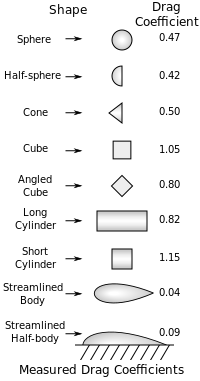
drag is a fluid dynamics term, sometimes called as air resistance or fluid resistance. It is defined as "forces that oppose the relative motion of an object through a fluid. Drag forces act in a direction opposite to the oncoming flow velocity". (wikipedia)
Shape and flow
  Form drag


   Skin friction
             
Flow plate.svg 0% 100%
Flow foil.svg ~10% ~90%
Flow sphere.svg ~90% ~10%
Flow plate perpendicular.svg 100% 0%


lift:
A fluid flowing past the surface of a body exerts a surface force on it. Lift is defined to be the component of this force that is perpendicular to the oncoming flow direction. It contrasts with the drag force, which is defined to be the component of the surface force parallel to the flow direction.(wikipedia)


Note: In aircrafts Lift/drag ratio is expected to be higher. But this is not the case in automobiles where lift is to be reduced and drag too to be reduced. What is especially required in an autombile such as a racing car is the downforce (as opposed to the lift required in aircrafts).


Upper: non-aerodynamic car; Lower: aerodynamically improved design
From: http://www.generalamherst.com

A diffuser is seen in most racing cars:


Rear diffuser of Porsche - Courtesy: Wikipedia


Rear spoiler of Toyota - Courtesy: Wikipedia


Front Air Dam of Mazda - Courtesy: Mazda

Please visit hotrod for a fine detailed description of the role of aerodynamics in automobiles!

Sunday, May 16, 2010

Internal Combustion (IC) Engines

Internal combustion engines have been a compact method to drive a generator to produce mechanical energy. IC engines can be mainly classified into two.
1. Diesel engines (Compression-ignition)
2. Petrol/gasoline engines (Spark-ignition)
Diesel and Gasoline engines are reprocating engines too as 1/more pistons move laterally to generate rotational energy which in turn used as a prime mover for either generators or simply as marine engines to drive the propeller.

The injection of fuel (either diesel or gasoline) can be direct or indirect.
  1. Direct injection is done by the help of specially designed fuel injectors. This is applicable mostly to diesel engines.
  2. Indirect injection is where fuel is not directly INJECTED. Actually this suits to gasoline engines. A carburrettor helps to DRAW the fuel rather than injecting it to the engine.This is applicable mostly to petrol engines. In modern cars, a carburettor is replaced by ELECTRONIC FUEL INJECTION (EFI), where injection is controlled by electronic means normally by a dedicated controller.

4-stroke cycle:
  1. Intake stroke
  2. Compression stroke
  3. Power stroke
  4. Exhaust stroke


Main Parts of a diesel generator set:


Mechanical components:

  1. cylinder liner
  2. piston
  3. connecting rod
  4. crankshaft
  5. camshaft
  6. push rod
  7. valve spring
  8. air inlet valve
  9. exhaust valve
  10. injector nozzle
  11. fuel pump
  12. ac pump
  13. fuel filter
  14. oil filter
  15. air filter
  16. oil sump
  17. fuel tank
  18. flywheel
  19. rocker arm
  20. governor
Electrical components:
    1. starting motor
    2. battery
    3. charging alternator
    4. gen stator
    5. gen rotor
    6. windings
    7. MVR/ AVR/ DVR
    8. DC generator/PM Generator - exciter
    9. rotating diode set
    10. oil pressure sensor
    11. water temperature sensor
    12. speed sensor
    13. gen control panel (GCP)
    14. gen circuit breaker (GCB)