The term renewable energy now has become a magical word in energy. The world is constantly changing and so is the power sector. Nowadays people talk about 'deviating' from the 'conventional' energy sources such as thermal, hydro, nuclear etc and magically spell wind, solar, biomass, wave, tidal, geothermal, and so on.
Are those viable and financially feasible? what about the technical feasibility - such as reliability, stability issues?
Wind energy:
Wind takes the first priority when it comes to non-conventioanl renewable energy source. Though it is unrelaible at times, may have stability issues, voltage problems, might need reactive power compensation. Still it is CLEAN, Not forgetting that it needs a very high initial investment in comparative terms. Remember that open cycle gas turbines are the opposite. Their capital cost is in the lower limits in any commercial scale power systems.
A Horizontal axis wind turbine generator: from Howstuffworks
Solar Energy:
Solar PV
Solar energy is said to be abundant, though the fabrication of these photovoltaic semiconductors are not so easy. their Cost/Wattage is significantly high and the average payback period is well beyond 10 years.
Solar thermal
Biomass Energy:
Wave/Tide Energy:
skip to main |
skip to sidebar
Fault Vs Abnormal condition:
Abnormal condition in a power system, as the word itself states, is a non-desirable state in a power system.
Best example is 'Overload' in a power system, where the load current is above the nominal rating of the system it is designed for.
Whereas Fault is an abnormal condition which is detrimental to the power system , and will be dangerous if not eliminated.
Best example is a short-circuit, whereby two phase conductors touch each other between the load and the generator - so that a very high current flows in the circuit.
Sequence analysis:
Balanced system is where in a 3-phase power system - the current flowing in all three phases are equal.
Unbalanced system is where in a 3-phase power system - the current flowing in all three phases are unequal.
Any unbalanced system can be represented by balanced systems containing 3 elements. Those are,
1. +ve sequence
2. -ve sequence
3. zero sequence
Vector addition of the above 3 elements will result in the former unbalanced system.
Protection Equipments:
Fuse:
1. Semi-enclosed
-found in domestic installations, rewirable.
rewirable fuse holders
2. Cartridge type
-found in electrical apparatus such as UPS etc, not re-wirable.
cartridge fuse
3. High Rupturing Capacity (HRC)
-normally found in the secondary (LV) side of transformers. This has high current capacity before breaking.
Knife-edged Low volatge HRC fuse links
Drop-down-lift-operate (DDLO) fuse:
These are sometimes called fusible cutouts.
This is a type of expulsion fuse, which is normally found in the HV side of transformers. When high current flows in the primary side (HV) of transformers - the fusing element (a special metal wire) will melt so that the connection will be cut-off due to gravity.
a DDLO in opened position
Miniature circuit breaker (MCB)
This is the protective device seen in modern homes, replacing older fuses. available in low current versions.
for e.g. 6A, 10 A, 16A etc. These MCBs normally have two tripping phenomena. one is magnetic coil used for instantaneous tripping ,and thermal bimetallic strips used for inverse-time overcurrent tripping.
These are available in different classes - considering the load current characteristics such as high inrush (starting) currents. High starting currents are caused when loads such as fluorescent lamps and motors are switched on.
single pole , three pole , four pole versions are available depending on the number of wires.
Moulded case circuit breaker (MCCB)
These are high current versions of domestic MCBs. Normally found in factories, utility bulk supply (3-phase) entry points.
3-phase currents in the orders of even 500A can be handled by these MCCBs.
Earth leakage circuit breaker (ELCB)
This is the older version of RCCBs. These devices detect the leakage current to earth and trip if that current exceeds a threshold, for e.g. 30mA, 100mA.
It should be noted that ELCB is a (residual)-voltage-operated device.
Residual current Devices (RCD)/ Residual current circuit breaker (RCCB)
This is a modern version of an ELCB, which works by comparing the residual current (resultant) produced - by means of checking the current difference between live and neutral wires .
It should be noted that RCCB is a (residual)-current-operated device.
Protective Relays:
1. Overcurrent (O/C) relays
2. Overload (O/L) relays
3. Earthfault (E/F) relays
4. Under frequency (U/F) relays
5. Overvoltage (O/V) relays
6. Distance relays
7. Differential relays
8. Reverse power (R/P) relays
9. Bucholz relays
10. Directional relays
11. Overspeed (O/S) relays
Arcing Horns/ gaps:
These are sometimes employed in transformer HV terminals or between the terminals of an HV insulator, to protect them from lightning surges. This works on the simple principle of HV rod-gap breakdown.
High Voltage Circuit breakers:
This was earlier explained in the post - "Grid sub stations"
***
Exploring into a deep & broad insight of Electrical Power Engineering
Showing posts with label Power Generation. Show all posts
Friday, May 28, 2010
Tuesday, January 19, 2010
Power System Protection
Fault Vs Abnormal condition:
Abnormal condition in a power system, as the word itself states, is a non-desirable state in a power system.
Best example is 'Overload' in a power system, where the load current is above the nominal rating of the system it is designed for.
Whereas Fault is an abnormal condition which is detrimental to the power system , and will be dangerous if not eliminated.
Best example is a short-circuit, whereby two phase conductors touch each other between the load and the generator - so that a very high current flows in the circuit.
Transformer getting fire due to fault
Image from: www.seeclab.com
Sequence analysis:
Balanced system is where in a 3-phase power system - the current flowing in all three phases are equal.
Unbalanced system is where in a 3-phase power system - the current flowing in all three phases are unequal.
Any unbalanced system can be represented by balanced systems containing 3 elements. Those are,
1. +ve sequence
2. -ve sequence
3. zero sequence
Vector addition of the above 3 elements will result in the former unbalanced system.
Protection Equipments:
Fuse:
1. Semi-enclosed
-found in domestic installations, rewirable.
rewirable fuse holders
-found in electrical apparatus such as UPS etc, not re-wirable.
cartridge fuse
3. High Rupturing Capacity (HRC)
-normally found in the secondary (LV) side of transformers. This has high current capacity before breaking.
Knife-edged Low volatge HRC fuse links
Drop-down-lift-operate (DDLO) fuse:
These are sometimes called fusible cutouts.
This is a type of expulsion fuse, which is normally found in the HV side of transformers. When high current flows in the primary side (HV) of transformers - the fusing element (a special metal wire) will melt so that the connection will be cut-off due to gravity.
a DDLO in opened position
Miniature circuit breaker (MCB)
This is the protective device seen in modern homes, replacing older fuses. available in low current versions.
for e.g. 6A, 10 A, 16A etc. These MCBs normally have two tripping phenomena. one is magnetic coil used for instantaneous tripping ,and thermal bimetallic strips used for inverse-time overcurrent tripping.
These are available in different classes - considering the load current characteristics such as high inrush (starting) currents. High starting currents are caused when loads such as fluorescent lamps and motors are switched on.
single pole , three pole , four pole versions are available depending on the number of wires.
Moulded case circuit breaker (MCCB)
These are high current versions of domestic MCBs. Normally found in factories, utility bulk supply (3-phase) entry points.
3-phase currents in the orders of even 500A can be handled by these MCCBs.
Earth leakage circuit breaker (ELCB)
This is the older version of RCCBs. These devices detect the leakage current to earth and trip if that current exceeds a threshold, for e.g. 30mA, 100mA.
It should be noted that ELCB is a (residual)-voltage-operated device.
Residual current Devices (RCD)/ Residual current circuit breaker (RCCB)
This is a modern version of an ELCB, which works by comparing the residual current (resultant) produced - by means of checking the current difference between live and neutral wires .
It should be noted that RCCB is a (residual)-current-operated device.
Protective Relays:
1. Overcurrent (O/C) relays
2. Overload (O/L) relays
3. Earthfault (E/F) relays
4. Under frequency (U/F) relays
5. Overvoltage (O/V) relays
6. Distance relays
7. Differential relays
8. Reverse power (R/P) relays
9. Bucholz relays
10. Directional relays
11. Overspeed (O/S) relays
Arcing Horns/ gaps:
These are sometimes employed in transformer HV terminals or between the terminals of an HV insulator, to protect them from lightning surges. This works on the simple principle of HV rod-gap breakdown.
High Voltage Circuit breakers:
This was earlier explained in the post - "Grid sub stations"
***
Wednesday, January 13, 2010
Thermal power stations
When we say thermal power stations, it really means a coal-fired power plant with steam turbines(ST). But , in common language, it may include diesel engine(DG) power plants, gas-turbine(GT) powered plants or even combined-cycle(CCY) power plants.
Coal-fired steam turbines:
Since coal is expected to be more abundant than other fossil fuels such as diesel, petrol, natural gas - and because of it's low cost , coal power plants are installed in most power systems as base load catering plants.
A coal power plant, showing cooling tower
Gas-turbines:
The main elements of a gas-turbine are,
1.Compressor
2.Combustor
3.Turbine
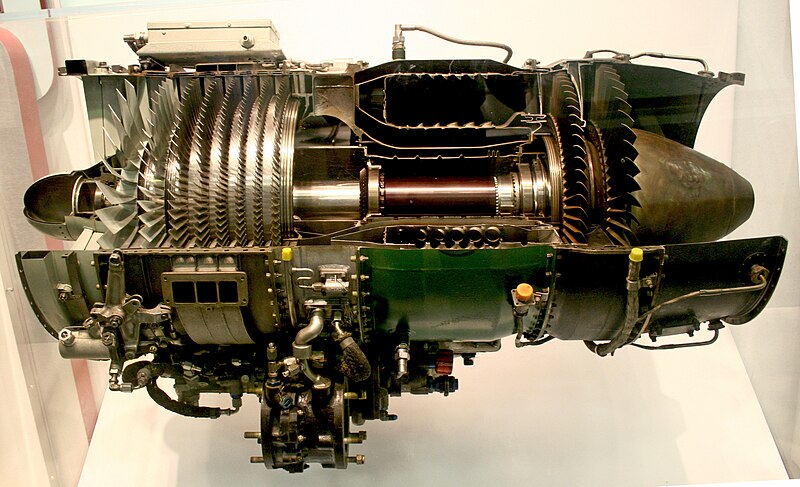
A General Electric gas-turbine which was used in a US military jet-aircraft
Combined-cycle power plants:
In order to increase the efficieny of gas turbines, combined cycle plants were introduced. These plants utilise the still hot exhausts left out to the atmosphere to heat water pipes. this effects to be a steam turbine and significant efficiency improvement is done.
Model diagram of a CCY plant, showing a gas turbine and a steam turbine
Diesel-Engines:
Diesel engine powered plants are a kind of Internal combustion engines. Normally petrol-based (gasoline) engines are spark-ignitioned. This means every combustion cycle is initiated by a HV spark provided by spark-plugs. But big diesel-based engines are compression-ignitioned. The compression of air produces heat and, makes the incoming tiny particles of diesel get ignited.
main elements in a diesel engine are,
1. cylinder
2. Piston
3. nozzles
4. diesel pump
5. set of valves
6. air, oil, fuel filters
7. exhaust opening
8.silencer
etc...
3 major liquids are required for the correct operation of any diesel engine. Those are;
* good fuel (slag-free, water-free, dust-free diesel)
* good engine oil
*good cooling water (particle-free, calcium compound-free purified water)
Coal-fired steam turbines:
Since coal is expected to be more abundant than other fossil fuels such as diesel, petrol, natural gas - and because of it's low cost , coal power plants are installed in most power systems as base load catering plants.
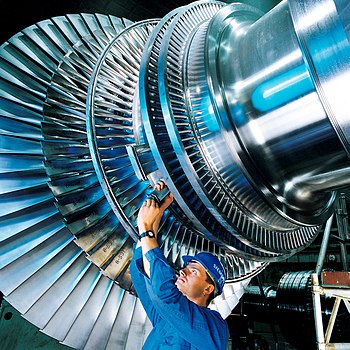
The turbine of a modern steam-turbine-generator
The main elements of a gas-turbine are,
1.Compressor
2.Combustor
3.Turbine
A General Electric gas-turbine which was used in a US military jet-aircraft
Combined-cycle power plants:
In order to increase the efficieny of gas turbines, combined cycle plants were introduced. These plants utilise the still hot exhausts left out to the atmosphere to heat water pipes. this effects to be a steam turbine and significant efficiency improvement is done.
Diesel-Engines:
Diesel engine powered plants are a kind of Internal combustion engines. Normally petrol-based (gasoline) engines are spark-ignitioned. This means every combustion cycle is initiated by a HV spark provided by spark-plugs. But big diesel-based engines are compression-ignitioned. The compression of air produces heat and, makes the incoming tiny particles of diesel get ignited.
main elements in a diesel engine are,
1. cylinder
2. Piston
3. nozzles
4. diesel pump
5. set of valves
6. air, oil, fuel filters
7. exhaust opening
8.silencer
etc...
Principle of diesel engine
from: www.rkm.com.au
3 major liquids are required for the correct operation of any diesel engine. Those are;
* good fuel (slag-free, water-free, dust-free diesel)
* good engine oil
*good cooling water (particle-free, calcium compound-free purified water)
Tuesday, January 12, 2010
Power & Power factor
In simple terms power is the work done in a unit time.
Its SI unit is Watts (W). Basic equation of electric power = P = V*I
Other main expression related to voltage/ current/ power is 'rms'.This means 'root-mean-square'. This is derived by first taking square - then getting the average - and finally taking the square root for a formula representing certain electrical quantity.
Other expressions similar to rms are, average and peak values of an electrical quantity. The rms, peak & average values of a Sine wave is illustarted below.
V = Vpk*Sin(θ)
Vrms= Vpk/(root 2)
Electric power is viewed as 3 different quantities, but related to each other.
1. Apparent power (S)
2. Active/Real power (P)
3. Reactive power (Q)
where,
S= V*I ;
P= V*I*Cos(φ) ; φ - phase angle difference between the current and voltage waveforms
Q=V*I*Sin(φ)
It is notable that:
S^2= P^2 + Q^2 ; ^2 - square of that quantity
Technically speaking, Cos(φ) is called the 'power factor' (p.f.) of that particular electrical system.
In a nutshell, active power relates to the actual work done, while reactive power is a loss to the system - BUT it is inevitable.
As we know the power factor is Cos(φ), it's further differentiated into leading power factor and lagging power factor. Leading occurs when the current waveform leads the volatge waveform (in time/angular axis); and lagging p.f. occurs at the opposite occasion.
Here Inductors and Capacitors come into play. Whatever conductor coiled spatially provides an inductance, and whatever two electrical terminals - having an insulator (air, paper etc) in between, provides capacitance.
Both Inductors and capacitors are reactive loads. But pure capacitors offer leading power factor while pure inductors offer lagging power factor to the supply side of the system.
Normally, a power system is inductive. This is because, when it is loaded - winding in transformers, windings in induction motors make the most of the power system. Hence the inductance present in these loads would offer leading power factor to the system.
(Note: Induction motors make up very significant portion of an industrialised power system, which are used in elevators, factories, industrial pumps etc.)
But, it should be noted that - long extra high voltage transmission lines are found to be capacitive; means those offer leading power factor. Similarly it is claimed that unloaded transmission lines have a tendency to show leading power factor.
Technically speaking, how does a transmission line gets capacitance?
1. capacitance between every phase and earth
2. capacitance between each of the phases
3. capacitance between each phases and trees/objects etc.
Its SI unit is Watts (W). Basic equation of electric power = P = V*I
Other main expression related to voltage/ current/ power is 'rms'.This means 'root-mean-square'. This is derived by first taking square - then getting the average - and finally taking the square root for a formula representing certain electrical quantity.
Other expressions similar to rms are, average and peak values of an electrical quantity. The rms, peak & average values of a Sine wave is illustarted below.
V = Vpk*Sin(θ)
Vrms= Vpk/(root 2)
Electric power is viewed as 3 different quantities, but related to each other.
1. Apparent power (S)
2. Active/Real power (P)
3. Reactive power (Q)
where,
S= V*I ;
P= V*I*Cos(φ) ; φ - phase angle difference between the current and voltage waveforms
Q=V*I*Sin(φ)
It is notable that:
S^2= P^2 + Q^2 ; ^2 - square of that quantity
Technically speaking, Cos(φ) is called the 'power factor' (p.f.) of that particular electrical system.
In a nutshell, active power relates to the actual work done, while reactive power is a loss to the system - BUT it is inevitable.
As we know the power factor is Cos(φ), it's further differentiated into leading power factor and lagging power factor. Leading occurs when the current waveform leads the volatge waveform (in time/angular axis); and lagging p.f. occurs at the opposite occasion.
Here Inductors and Capacitors come into play. Whatever conductor coiled spatially provides an inductance, and whatever two electrical terminals - having an insulator (air, paper etc) in between, provides capacitance.
Both Inductors and capacitors are reactive loads. But pure capacitors offer leading power factor while pure inductors offer lagging power factor to the supply side of the system.
Normally, a power system is inductive. This is because, when it is loaded - winding in transformers, windings in induction motors make the most of the power system. Hence the inductance present in these loads would offer leading power factor to the system.
(Note: Induction motors make up very significant portion of an industrialised power system, which are used in elevators, factories, industrial pumps etc.)
But, it should be noted that - long extra high voltage transmission lines are found to be capacitive; means those offer leading power factor. Similarly it is claimed that unloaded transmission lines have a tendency to show leading power factor.
Image obtained from: www.nationalgrid.com
Technically speaking, how does a transmission line gets capacitance?
1. capacitance between every phase and earth
2. capacitance between each of the phases
3. capacitance between each phases and trees/objects etc.
Friday, December 25, 2009
Hydro-Power Stations
Since water resources are abundant around the globe, generation of electricity by means of hydro-turbines is not a novel method.
There are mainly 2 types in the utilisation of hydro energy for power generation:
1. Reservoir type (see the above figure)
2. Run-of-River type (for a good illustration see this)
3. Pumped storage (see this picture)
Reservoir type plants store river water in natural/ artificial Dam structures. At the same time, Run-of-River type does not employ any permanent storage but depends on a diversion of an existing river.
In Sri Lanka, Victoria and Randenigala are few examples of big water reservoirs used for hydro-power, coming under the Mahaweli irrigation scheme.
Due to the nature of not having a permanent storage, Run-of-River type power stations suffer in drought seasons.
A big hydro power station will normally consist of the following elements after the dam.
1. Water Tunnel: to draw water from the reservoir
2. Penstock: to deliver water to the hydro turbines
3. Valves: before and after the Penstock for operation and safety
Hydro turbine is a mechanical device which is rotated by the energy imparted by the massive flow of water. Those are classified depending on their Head-charactersitics.
1. Kaplan Turbine
2. Francis Turbine
3. Turgo Turbine
4. Pelton Turbine
It is notable that the rotational speed of Hydro-turbines is considerably lesser than that of Gas-Turbines found in Thermal power stations.
Hydro turbines are coupled with the alternators (AC Generators) either horizontally or vertically.
Useful Power (in MW) developed by the alternator is controllable by adjusting the control gates called ‘Guide Vanes’, which determine the amount of water flow into the turbine.
Potential Energy of flowing Water = m*g* h ………. in usual notations]
=> Power output of Turbine = (m*g*h) / t
= (m/t)*g*h
= (water flow rate)*g*h ………..g, h are constants
=> Power output of Turbine IS PROPORTIONAL TO water flow rate, for a given head (h)
***
There are mainly 2 types in the utilisation of hydro energy for power generation:
1. Reservoir type (see the above figure)
2. Run-of-River type (for a good illustration see this)
3. Pumped storage (see this picture)
Reservoir type plants store river water in natural/ artificial Dam structures. At the same time, Run-of-River type does not employ any permanent storage but depends on a diversion of an existing river.
In Sri Lanka, Victoria and Randenigala are few examples of big water reservoirs used for hydro-power, coming under the Mahaweli irrigation scheme.
Due to the nature of not having a permanent storage, Run-of-River type power stations suffer in drought seasons.
A big hydro power station will normally consist of the following elements after the dam.
1. Water Tunnel: to draw water from the reservoir
2. Penstock: to deliver water to the hydro turbines
3. Valves: before and after the Penstock for operation and safety
Hydro turbine is a mechanical device which is rotated by the energy imparted by the massive flow of water. Those are classified depending on their Head-charactersitics.
1. Kaplan Turbine
2. Francis Turbine
3. Turgo Turbine
4. Pelton Turbine
Impulse turbines Vs. Reaction turbines
Hydro turbines are coupled with the alternators (AC Generators) either horizontally or vertically.
Useful Power (in MW) developed by the alternator is controllable by adjusting the control gates called ‘Guide Vanes’, which determine the amount of water flow into the turbine.
Potential Energy of flowing Water = m*g* h ………. in usual notations]
=> Power output of Turbine = (m*g*h) / t
= (m/t)*g*h
= (water flow rate)*g*h ………..g, h are constants
=> Power output of Turbine IS PROPORTIONAL TO water flow rate, for a given head (h)
***
Saturday, December 12, 2009
An introduction: Basic electricity and power engineering
Electricity is a form of energy, at the same time, a power source. It is an energy source when it is captured for a length of time and a power source when it is seen in a momentary time (instantaneous).
Normally electricity is produced where a form of energy is converted into another form of energy.
eg: 1. Chemical energy -> Electrical energy : Wet and dry cell batteries
2. Mechanical energy -> Electrical energy : Turbine generators
3. Light energy -> Electrical energy : Solar Photovoltaic panels
In another point of view, there are lot of methods electricity is produced in commercial scale. those are,
- Steam power plants
- Gas power plants
- Diesel power plants
- Bio mass power plants
- Geo thermal power plants
- Solar power plants
- Wind power plants
- Nuclear power plants
etc.
For a long time, electricty was seen as flow of positive energy particles through a completed circuit. But later it was found out that it is the 'free electrons' which contribute to the flow of 'charges'. That is why conventinally current is denoted in the direction of + to - in a 1.5 V dry cell battery - whereas the electrons flow in the opposite direction.
(note that flow of negatively charged particles ASSOCIATED with the imaginary flow of positive paticles called 'holes' is the true representation of the electricity)
Electrical parameters - Unit
1. Voltage difference - Volts
2. Current -Amperes
3. Power - Watts*
* there are other units as well, with different meanings- of electrical power.
A perfect analogy of current flowing in a conductor is, similar to water flowing in a sland (sloped) pipe,
Where the waterflow is like the electric current; voltage difference is like the slope of pipe and the electric power is the work done on flowing water per unit time.
When electric current is flowing in a conductor, it creates magnetic field lines along the conductor. When a voltage is present in a node (a point), it creates electric field lines around that node. Theoretically speaking, electromagnetic wave is made up of electric and magnetic fields which are perpedicular- propagating in a direction under certain circumstances. But a simple study of basic electricity is different from the complex study and mathematics of this field interaction in an electromagnetic wave. so this topic will not be discussed here now.
When considering the electrical conductivity of materials, common materials are devided into 3 categories.
1. conductors* (copper, aluminium, gold, carbon rod etc)
2. insulators (mica, poly-ethene, plastics, porcelain etc)
3. semi-conductors (doped silicon, doped germanium)
* At present, there is a further classification of 'super conductors'. Some special materials - in extreme circumstances like very low temperature have superconductivity; a state where electrical resistance is almost negligible. This has again wonderful applications (like semi conductors) in the field, for eg., superconductivity is used to obatain ultra high powerful electro-magnets used in electric trains.
Note that pure Silicon is an insulator. They become semi-conductors if they are doped with other elements like Boron or phosporous. These materials are of utmost importance in the electronics industry and revolutionised the world by the discovery of 'Semiconductor Transistors' in the Bell laboratories.
Current in a circuit can be direct or alternating. It is called direct (dc) when the polarity or direction of the current does not change with time.It is called alternating (ac) when the polarity does change with time in a definite manner such as changing 50 times per second. This leads to the 50 Hz electrical supply. In most parts of Americas, the supply will change it's polarity 60 times (60 Hz).
An ac supply can be of single phase (2/3 wires) or polyphased. The most popular polyphase power system is three-phase(3/4 wires) electricity supply. A three phase system is more economical than seperate single phase systems.
In a utility's (power company) point of view, a power system is seen in three major steps;
1. Power generation
2. Power transmission
3. Power distribution.
In a consumers point of view, a power system is seen as 'Power utilisation', which includes supply reliability, supply quality and energy efficiency.
The domestic power supply (in Sri Lanka) has the following characteristics.
1. Supply voltage is at 230 V ac
2. The incoming supply has two ac terminals: Live and Neutral wires
3. In addition, there is a ground/earth wire installed in the home premises.
4. Supply frequency is 50 Hz.
The major electrical machines involved in a power system are,
1. Generators
2. Motors
3. Transformers
Generators are further classified into ac, dc generators; while motors are classified into synchronous, asynchronous motors; And transformers can be classified into step up, step down transformers.
Normally electricity is produced where a form of energy is converted into another form of energy.
eg: 1. Chemical energy -> Electrical energy : Wet and dry cell batteries
2. Mechanical energy -> Electrical energy : Turbine generators
3. Light energy -> Electrical energy : Solar Photovoltaic panels
In another point of view, there are lot of methods electricity is produced in commercial scale. those are,
- Steam power plants
- Gas power plants
- Diesel power plants
- Bio mass power plants
- Geo thermal power plants
- Solar power plants
- Wind power plants
- Nuclear power plants
etc.
For a long time, electricty was seen as flow of positive energy particles through a completed circuit. But later it was found out that it is the 'free electrons' which contribute to the flow of 'charges'. That is why conventinally current is denoted in the direction of + to - in a 1.5 V dry cell battery - whereas the electrons flow in the opposite direction.
(note that flow of negatively charged particles ASSOCIATED with the imaginary flow of positive paticles called 'holes' is the true representation of the electricity)
Electrical parameters - Unit
1. Voltage difference - Volts
2. Current -Amperes
3. Power - Watts*
* there are other units as well, with different meanings- of electrical power.
A perfect analogy of current flowing in a conductor is, similar to water flowing in a sland (sloped) pipe,
Where the waterflow is like the electric current; voltage difference is like the slope of pipe and the electric power is the work done on flowing water per unit time.
When electric current is flowing in a conductor, it creates magnetic field lines along the conductor. When a voltage is present in a node (a point), it creates electric field lines around that node. Theoretically speaking, electromagnetic wave is made up of electric and magnetic fields which are perpedicular- propagating in a direction under certain circumstances. But a simple study of basic electricity is different from the complex study and mathematics of this field interaction in an electromagnetic wave. so this topic will not be discussed here now.
When considering the electrical conductivity of materials, common materials are devided into 3 categories.
1. conductors* (copper, aluminium, gold, carbon rod etc)
2. insulators (mica, poly-ethene, plastics, porcelain etc)
3. semi-conductors (doped silicon, doped germanium)
* At present, there is a further classification of 'super conductors'. Some special materials - in extreme circumstances like very low temperature have superconductivity; a state where electrical resistance is almost negligible. This has again wonderful applications (like semi conductors) in the field, for eg., superconductivity is used to obatain ultra high powerful electro-magnets used in electric trains.
Note that pure Silicon is an insulator. They become semi-conductors if they are doped with other elements like Boron or phosporous. These materials are of utmost importance in the electronics industry and revolutionised the world by the discovery of 'Semiconductor Transistors' in the Bell laboratories.
Current in a circuit can be direct or alternating. It is called direct (dc) when the polarity or direction of the current does not change with time.It is called alternating (ac) when the polarity does change with time in a definite manner such as changing 50 times per second. This leads to the 50 Hz electrical supply. In most parts of Americas, the supply will change it's polarity 60 times (60 Hz).
An ac supply can be of single phase (2/3 wires) or polyphased. The most popular polyphase power system is three-phase(3/4 wires) electricity supply. A three phase system is more economical than seperate single phase systems.
In a utility's (power company) point of view, a power system is seen in three major steps;
1. Power generation
2. Power transmission
3. Power distribution.
In a consumers point of view, a power system is seen as 'Power utilisation', which includes supply reliability, supply quality and energy efficiency.
The domestic power supply (in Sri Lanka) has the following characteristics.
1. Supply voltage is at 230 V ac
2. The incoming supply has two ac terminals: Live and Neutral wires
3. In addition, there is a ground/earth wire installed in the home premises.
4. Supply frequency is 50 Hz.
The major electrical machines involved in a power system are,
1. Generators
2. Motors
3. Transformers
Generators are further classified into ac, dc generators; while motors are classified into synchronous, asynchronous motors; And transformers can be classified into step up, step down transformers.
Labels
- Automation (1)
- Electrical Machines (1)
- High Voltage Engineering (1)
- Mechanical Engineering (3)
- Power Distribution (2)
- Power Electronics (1)
- Power Generation (6)
- Power Systems (1)
- Power Transmission (4)
- Power Utilisation (2)
Blog Archive
Links
- The art & science of protective relaying: the complete book
- Ontario Power generation: Technical documents in Nuclear reactors
- IIT India: National programme on technology enhanced learning
- Siemens: downloadable STEP courses
- National renewable energy laboratory: Student resources
- Occupational Safety & Health Administartion: Electric power glossary
About Me
Power Engineering is a part & parcel of Electrical Engineering which consists of the study & application of Power Systems. It can be further categorised into topics such as power generation, power transmission, power utilisation, electrical machines, power electronics, high voltage engineering, power system operation, planning, modelling, simulation, protection ...the list never ends!